

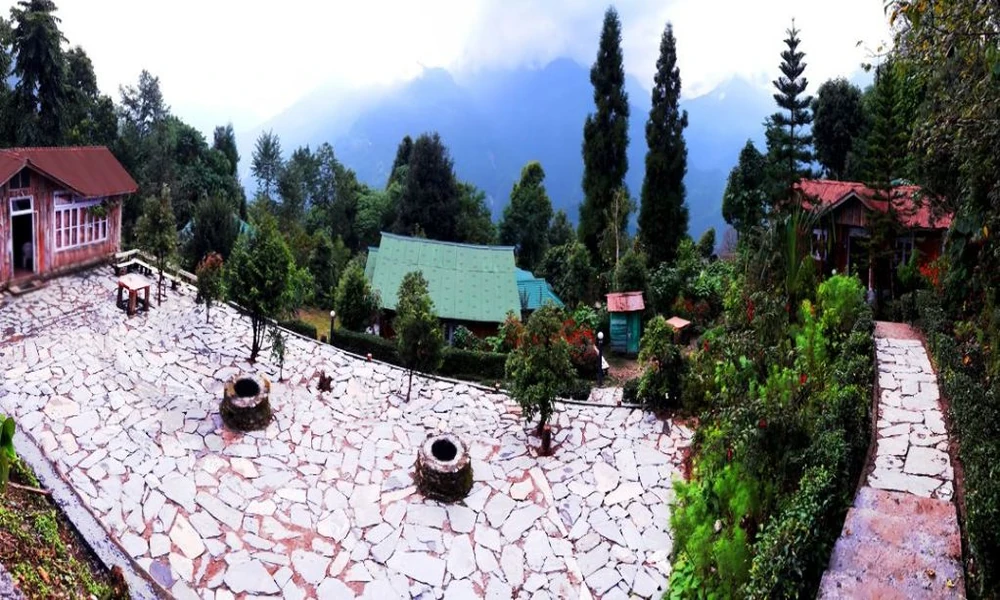
Borong is a quiet farming village in South Sikkim, about 17 km beyond Ravangla, and two unhurried days here give you sulphur hot springs by the Rangit river, old monasteries close by, birdsong at dawn, and homestay meals cooked over a wood fire. It is one of the easiest ways to try real village tourism in Sikkim.
What makes Borong worth two days?
Borong, Sikkim is the kind of place you go to do very little, and that is the whole point. Most people rush through Ravangla, tick the Buddha statue, and drive on. Borong asks you to stop.
The village sits on a shelf of terraced fields with big Himalayan peaks behind it. On a clear morning you can pick out Pandim, Kabru and Rathong from the courtyard of your homestay. There is no market strip, no honking, no queue. What you get instead is slow: a cup of tea, a walk down a cardamom path, and the sound of a river you cannot yet see.
Why it suits village tourism: you actually live with a local family, eat what they cook, and see how a small Sikkimese hill village runs its day. That mix of a natural hot spring, easy walks, and warm homestays is hard to find so close to a main town.
Day 1: Arriving, settling in, and an evening walk
We left Ravangla after lunch and reached Borong in under an hour. The last stretch is narrow and winding, so a local driver helps. By the time we dropped our bags, the light had gone soft and gold over the fields.
Our host handed us tea within five minutes. That is the rhythm here. You do not check in so much as you are taken in. We spent the first afternoon just walking the village lanes, past a small handmade paper unit and a few homes drying cardamom on their porches.
Dinner was simple and very good: rice, dal, a leafy green from the kitchen garden, and a plate of hot springy fritters. We ate early, the way the village does, and slept with the window open to a completely dark, quiet sky.
A tip for the first evening
Do not plan anything ambitious for arrival day. Roads in South Sikkim are slow and the last light is the prettiest part. Save the hot springs and the longer walk for a full second day when you are fresh.
Day 2: The Borong hot springs and a monastery detour
The reason many people come to Borong is the Borong Tsachu, the sulphur hot springs sitting right by the Rangit river. Locals call them Cha-chu and treat them as a winter healing spot rather than a tourist attraction.
You cannot drive to the spring. From the vehicle stop, it is a downhill hike of around 45 minutes to reach the riverbed where the pools are. Going down is easy and pretty. Coming back up, in the afternoon heat, is the real workout. Carry water and start early. Entry is free.
Season matters a lot here. The pools are properly set up and busiest in the cold months, roughly December to February, with February to April also good. In the monsoon the river runs high and the site is often unusable, so a two-day Borong trip built around the springs makes most sense in winter and early spring (as of 2026).
What to expect at the springs
- The water: Warm, cloudy and smelling of sulphur, which is exactly what people come for.
- Facilities: Basic. During the season, simple huts and small shops selling provisions come up. Outside the season, expect nothing, so carry your own supplies.
- The crowd: Mostly local families who stay for days to soak. It is a cultural scene as much as a bath.
If the hike or the season does not suit you, there is a good backup close by. Ralang Monastery, one of the important Kagyu monasteries in Sikkim, is a short drive away and worth an hour. Time your trip with its winter Mahakala dances if you can, and the whole valley comes alive.
How do you reach Borong, Sikkim?
You reach Borong by road through Ravangla, and there is no direct public transport into the village itself. The nearest airport is Bagdogra and the nearest railhead is New Jalpaiguri, both near Siliguri in West Bengal.
Common route: Siliguri or NJP to Melli to Namchi to Ravangla to Borong.
- By air: Bagdogra airport is about 144 km away, roughly a 5 hour drive.
- By train: New Jalpaiguri (NJP) is about 161 km away, a similar 5 to 6 hour drive.
- By road: Shared jeeps run from Siliguri and NJP to Ravangla. From Ravangla, hire a local cab for the final 17 km, since shared vehicles into Borong are rare.
A practical warning: do not count on reaching Ravangla late and finding an easy ride onward the same evening. Fix your Borong pickup in advance with your homestay or operator so you are not stranded at the Ravangla stand after dark.
Where should you stay in Borong?
Stay in a family-run homestay. That is not a compromise in Borong, it is the best part. You will not find big hotels or resorts here, and you would not want them.
Homestays are simple, clean and run by families who cook for you and often walk you around the village. Rooms are basic, hot water may come in a bucket, and the food is the highlight. A night usually includes home-cooked meals, which makes planning easy.
- Book ahead in season, since the village has limited rooms.
- Ask your host to arrange the hot spring guide and the local cab.
- Carry some cash. Card machines and steady mobile signal are not a given here.
When is the best time to visit Borong?
March to May gives you the clearest mountain views and comfortable days around 10 to 15 degrees. October and November are also lovely after the rains, with crisp air and clean skies.
If the hot springs are your main goal, plan for the cold season, roughly December to February, when the pools are set up and the local soaking tradition is in full swing. Avoid peak monsoon from June to early September, when landslides and a swollen river can spoil both the roads and the springs.
What should you pack?
- Layers and a warm jacket, since evenings get cold even in summer.
- Good grip shoes for the hot spring hike and village trails.
- A torch, a power bank, basic medicines, and cash.
Do you need a permit for Borong?
Indian travellers do not need any special permit for Borong or Ravangla. These are open areas of South Sikkim, so you can simply arrive and stay.
Foreign nationals need an Inner Line Permit to enter Sikkim, which is easy to get on arrival at the state entry points or through a registered operator. Rules can change, so confirm the current process before you travel.
Borong trip planner at a glance
| Detail | At a glance |
|---|---|
| Location | South Sikkim, Ravangla subdivision, about 1,800 m (5,800 ft) |
| Distance from Ravangla | Roughly 17 km, about 45 minutes by car |
| Nearest airport / rail | Bagdogra (~144 km) / New Jalpaiguri (~161 km), around 5 to 6 hours by road |
| Best time | March to May for clear views; December to February for the hot spring season |
| Stay | Family-run homestays and a few small nature stays |
| Star attraction | Borong Tsachu (hot sulphur springs) by the Rangit river |
| Ideal trip length | 2 days and 1 night, or 3 days if you add Ralang and Ravangla |
Borong, Sikkim: quick FAQ
Is Borong worth visiting?
Yes, if you want quiet sightseeing. Borong is ideal for village tourism, hot springs and mountain views, but it is not for travellers who want nightlife, shopping or packed itineraries.
How many days do you need in Borong?
Two days and one night is enough for the village and the hot springs. Add a third day if you want to fold in Ralang Monastery, Ravangla and the Buddha Park.
Are the Borong hot springs open all year?
No. They work best in the cold season, roughly December to February, and are often unusable during the monsoon when the Rangit runs high (as of 2026).
Is the hot spring hard to reach?
It is a downhill hike of about 45 minutes from the road, and the climb back is tiring. It is doable for most fit walkers, but not ideal for anyone with knee trouble.
Is there a mobile network in Borong?
Signal is patchy and depends on your operator. Treat it as a place to switch off, carry cash, and download your maps before you arrive.
Which is better, Borong or Ravangla?
Ravangla has more to see and better facilities. Borong is quieter and more rooted in village life. Many travellers base in Ravangla and add a night in Borong for the best of both.
Plan your Borong trip
Want help lining up a Borong homestay, a local cab from Ravangla, and the right season for the hot springs? Explore more Sikkim guides and trip ideas at https://sikkimtourism.org/ and plan a village stay that actually feels local.
